
What is aluminium?
At about one third of the density of steel, aluminium stands out for corrosion resistance and recyclability.
Physical, Chemical and Metallurgical Properties of Aluminium
Aluminium is the most abundant metal in the earth's crust. At around 2.7 g/cm³ it is considerably lighter than steel, and the oxide layer that forms naturally on its surface protects the metal from corrosion.
It can be shaped by extrusion, forging and casting. Alloying and heat treatment adjust strength values to the requirements of the application.
Aluminium can be remelted and reused many times, which makes it a preferred material for long-life building and transport applications.
| Property / Parameter | Technical Value | Engineering Advantage |
|---|---|---|
| Atomic Number / Symbol | 13 / Al | Most abundant metallic element in the Earth’s crust |
| Density (Specific Gravity) | ~2.70 g/cm³ | Roughly one-third the density of carbon steel (~7.85 g/cm³) |
| Melting Point (Pure Al) | ~660.3 °C | Enables efficient remelting and hot extrusion (450–500 °C) |
| Modulus of Elasticity (E) | ~70 GPa | Extruded hollow geometry optimizes moment of inertia |
| Thermal Conductivity (6060/6063) | ~200 – 210 W/(m·K) | Ideal for electronic heat sinks and LED housings |
| Recyclability | 100% (Without property loss) | Saves ~95% energy compared with primary smelting |
FAQ
How much lighter is aluminium compared to structural steel?
Aluminium has a density of ~2.70 g/cm³, roughly one-third that of carbon steel (~7.85 g/cm³), enabling up to 50–65% weight savings in engineered structural profiles.
Does recycled secondary aluminium lose mechanical strength?
No. When alloyed and refined within EN 573-3 chemical limits, certified secondary billets deliver the exact same EN 755-2 mechanical properties while reducing embodied energy by up to 95%.
Related Engineering & Manufacturing Resources

5000, 6000 & 7000 Series Alloys (EN 573-3 / EN 755-2)
Chemical composition and mechanical property tables for EN AW-5083, 5754, 6060, 6063, 6005A, 6082, 6463, 7020 and 7075.
Read more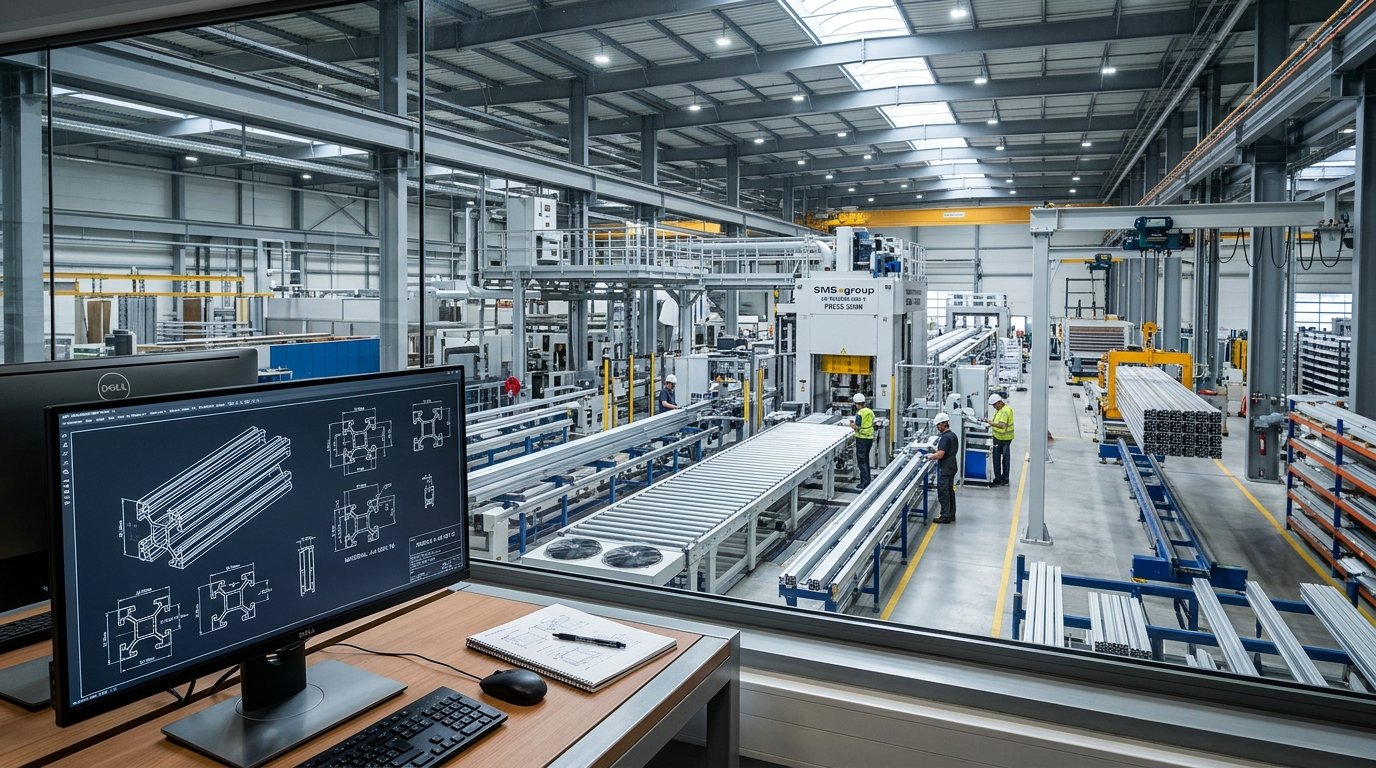
Plant, 5-6-7 Inch Presses & Small-Part Finishing
5-6-7 inch (1,000–2,000 t) presses, 80–20,000 g/m, min. 0.8 mm wall, bar/small-part anodizing & 8–6,000 mm cutting.
Read more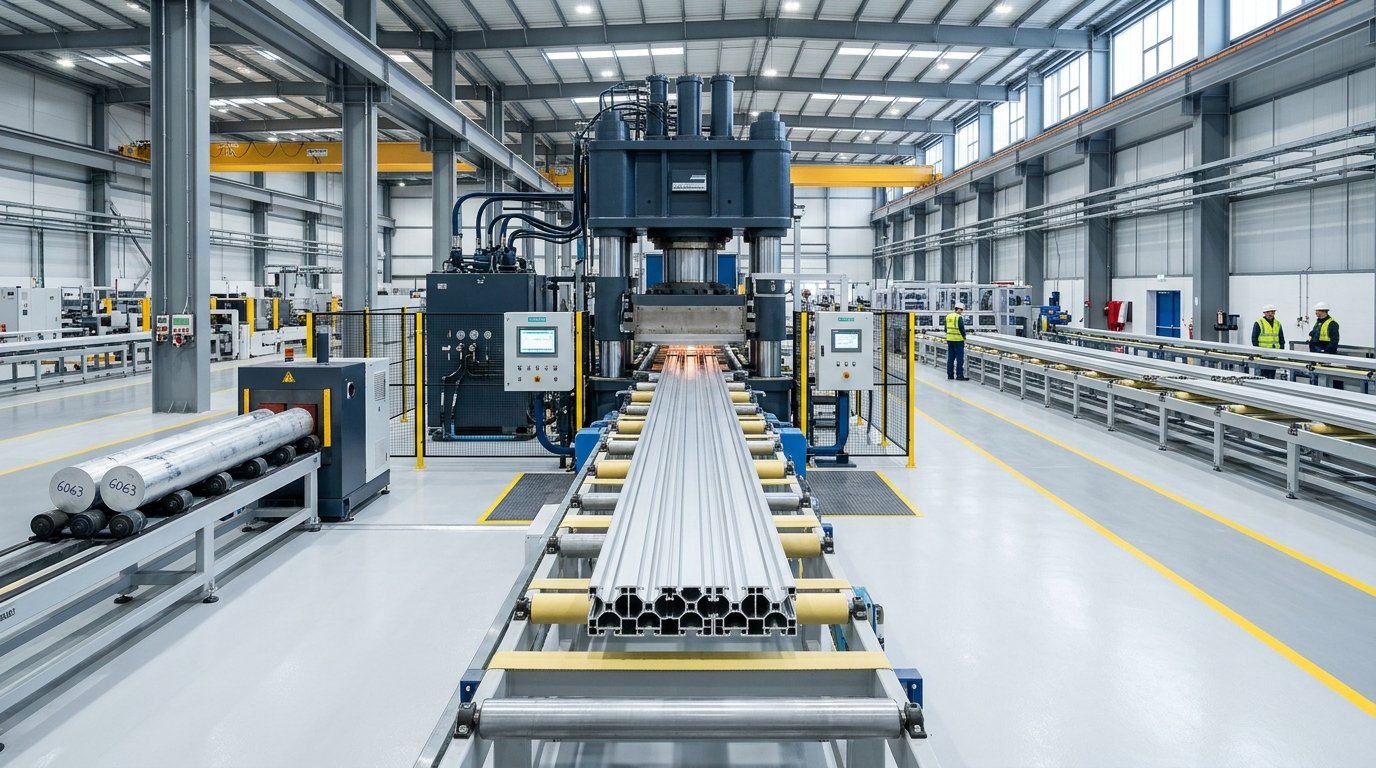
All Production Services (8 Integrated Units)
From custom dies and standard profiles to 5000-6000-7000 extrusion, small-part anodizing/coating and all-angle CNC.
Read more
Request a Quote
Send your section drawing and annual volume; the quotation is prepared together with the die and production plan.