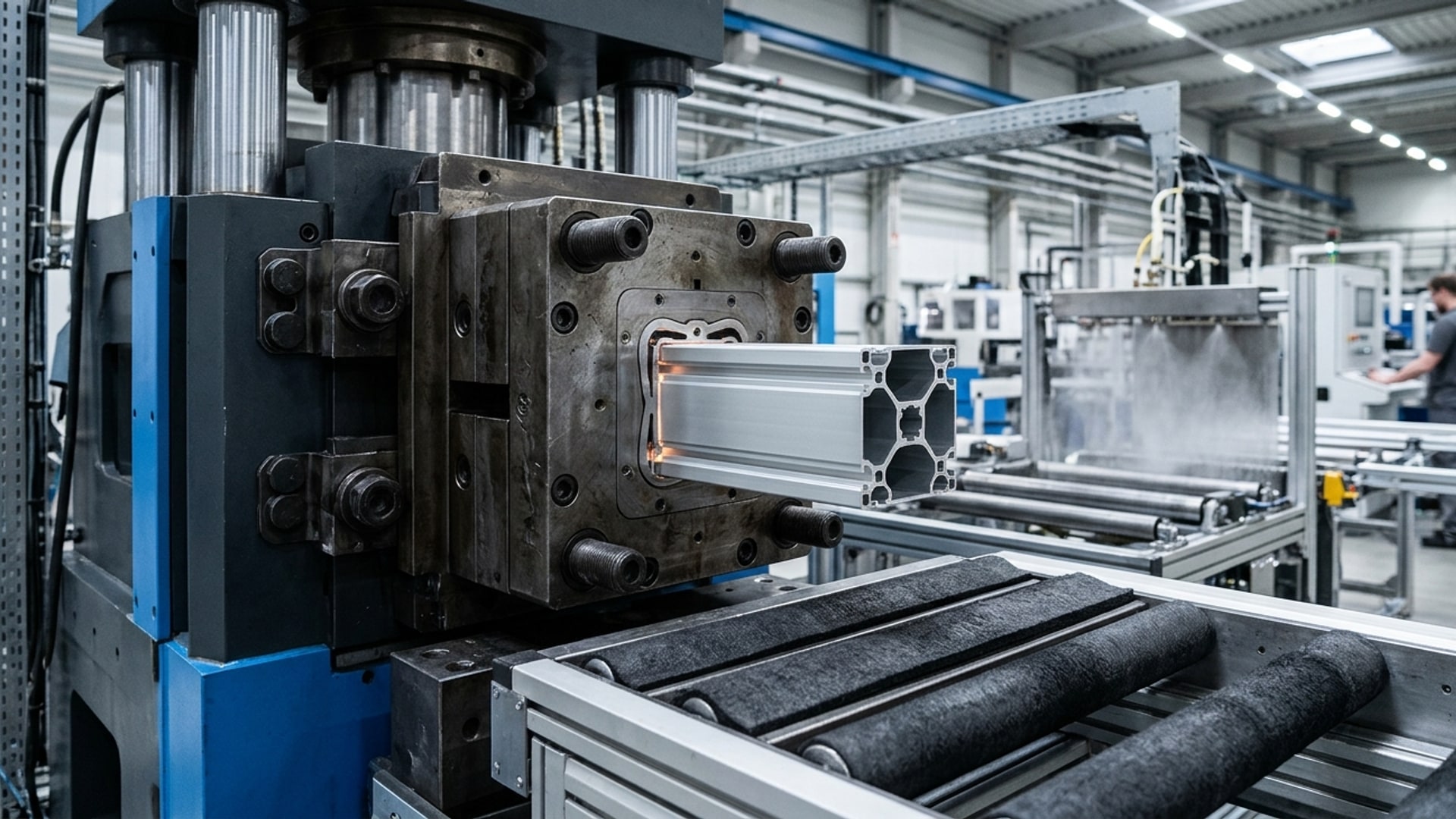
What is extrusion?
A heated aluminium billet is pushed through a die to form a continuous profile.
Aluminium Extrusion Process Mechanics and Thermal Stages
In extrusion the billet is heated to about 450–500 °C and pushed from the container through the die. The profile is cooled at the die exit, then cut to length and straightened.
The section geometry comes from the die: wall thickness, corner radii and cavities are defined at the design stage. Cooling rate and temper directly affect the mechanical properties.
Aging in the furnace delivers T5 or T6 tempers, followed by the surface treatment and machining steps.
| Process Stage | Typical Parameter / Range | Metallurgical & Dimensional Purpose |
|---|---|---|
| 1. Billet Preheating | 450 °C – 500 °C | Homogenize Mg₂Si phase and achieve plastic flow |
| 2. Die Extrusion | Flat (solid) or Porthole (hollow) die | Form profile cross-section per EN 755-9 / EN 12020-2 |
| 3. Press Exit Quenching | Forced air or water-mist quench | Lock alloying elements in supersaturated solid solution |
| 4. Cold Stretching | 0.5% – 2.0% controlled elongation | Relieve residual stress and straighten twist/bow |
| 5. Artificial Aging | 175 °C – 205 °C (4 – 8 hours) | Precipitate Mg₂Si to achieve T5, T6 or T66 strength |
FAQ
How are hollow multi-chamber aluminium profiles extruded?
Using a two-part porthole mandrel die: heated aluminium splits around internal bridges and solid-state welds back together inside the welding chamber before exiting the die bearing.
What determines the minimum wall thickness in extrusion?
Minimum wall thickness (down to 0.8 mm on our 5–7 inch presses) depends on alloy flow stress, circumscribing circle diameter (CCD) and section symmetry—6060/6063 allow the thinnest walls.
Related Engineering & Manufacturing Resources

5000, 6000 & 7000 Series Alloys (EN 573-3 / EN 755-2)
Chemical composition and mechanical property tables for EN AW-5083, 5754, 6060, 6063, 6005A, 6082, 6463, 7020 and 7075.
Read more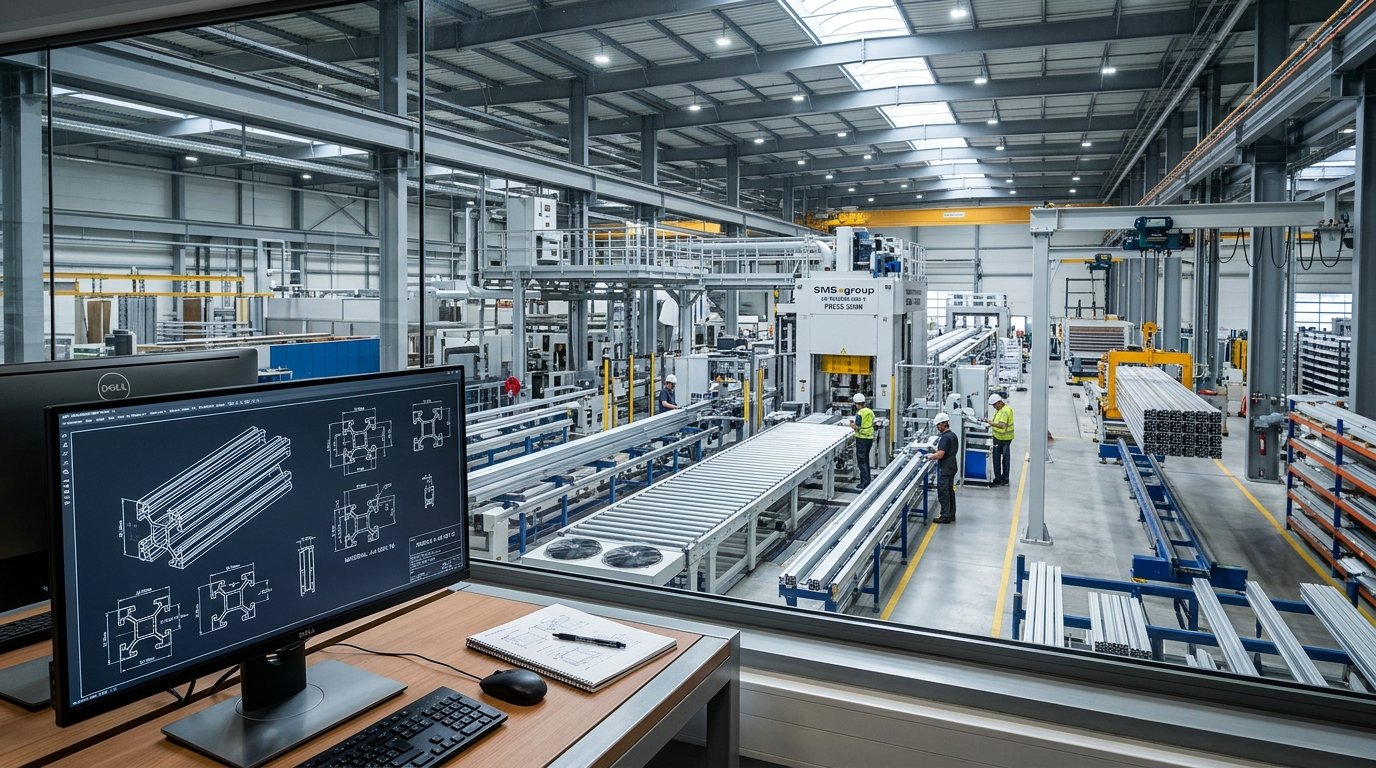
Plant, 5-6-7 Inch Presses & Small-Part Finishing
5-6-7 inch (1,000–2,000 t) presses, 80–20,000 g/m, min. 0.8 mm wall, bar/small-part anodizing & 8–6,000 mm cutting.
Read more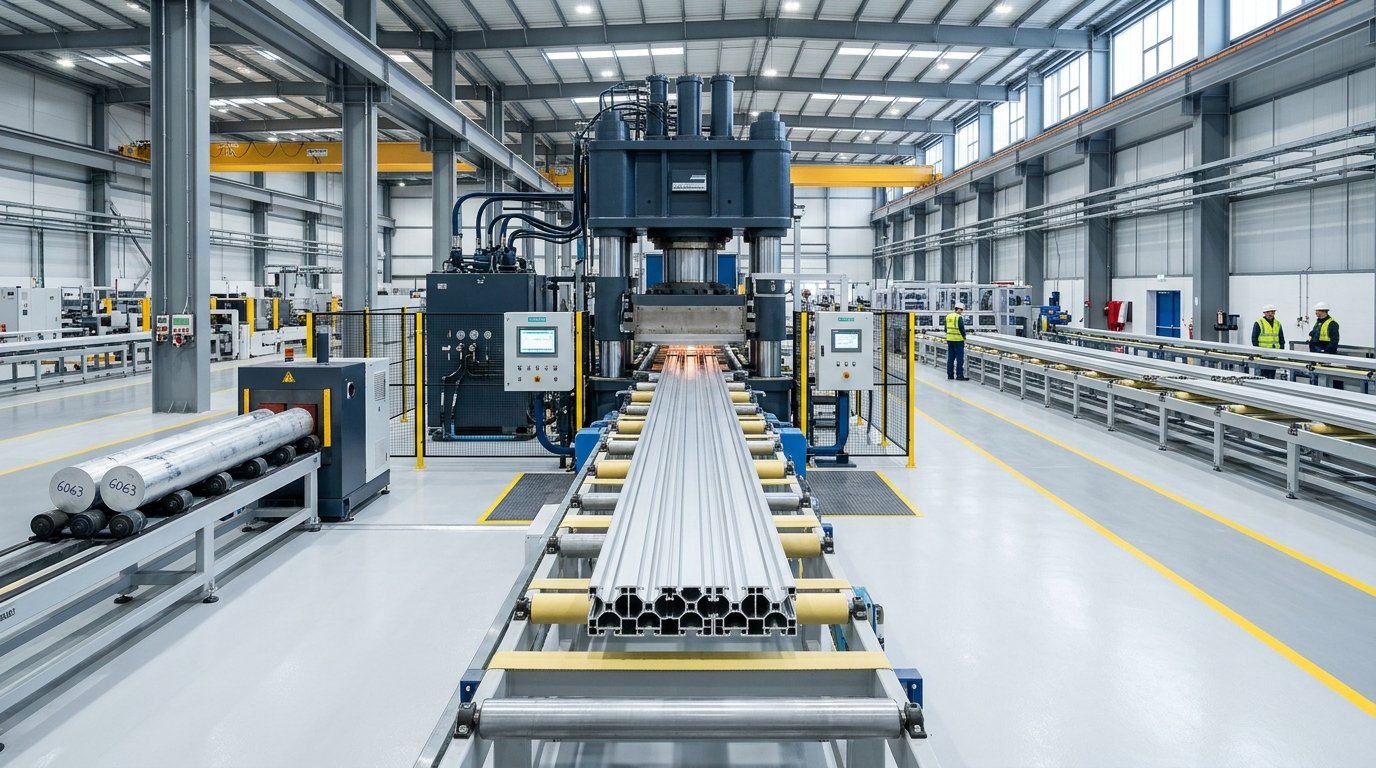
All Production Services (8 Integrated Units)
From custom dies and standard profiles to 5000-6000-7000 extrusion, small-part anodizing/coating and all-angle CNC.
Read more
Request a Quote
Send your section drawing and annual volume; the quotation is prepared together with the die and production plan.